
Bear-Proof Beehives: Electric Fence Specs From Wildlife Agencies
Bear proofing bee hives comes down to an electric fence, and the agencies do not all publish the same numbers. Here is each source's spec side by side, and the one IGBC-listed beehive enclosure.
On this page8 sections
Agencies agree on the method, an electric fence, but not on a single set of numbers. We show each source as published instead of blending them into an average nobody wrote.
This guide repeats what named sources say, with links at the bottom. Where a source is not a government agency, we say so. Nothing here guarantees a fence will stop a bear.
Why Bears Raid Beehives, and Why Fences Are the Answer
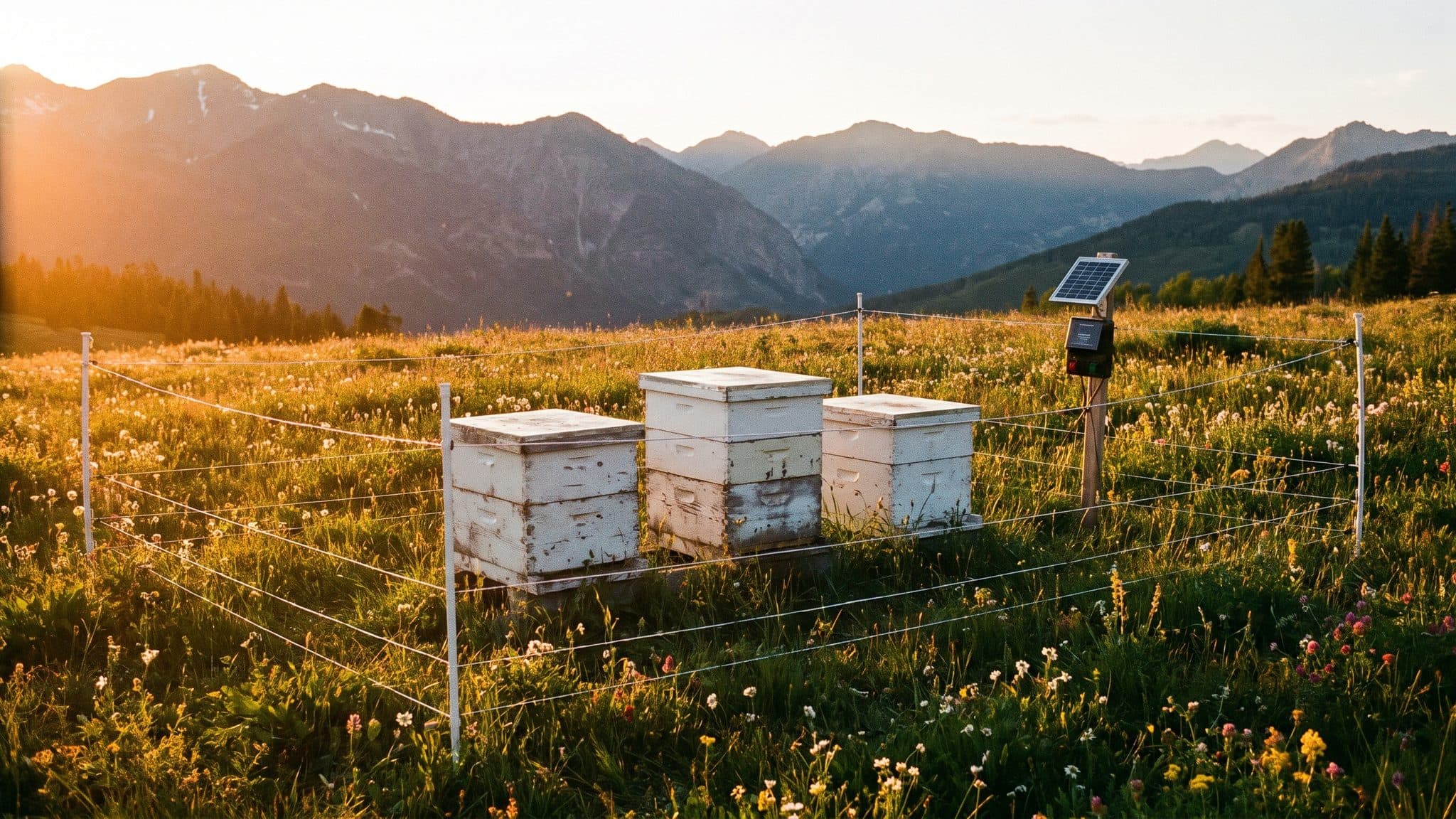
UF/IFAS Extension says bears seek out honey bee nests mainly to eat the protein-rich brood (larvae and pupae), with honey as a sweet treat, and that once bears get a taste they often return to a bee yard multiple times. It says most beekeepers keep bears away with temporary or permanent electric fences around the apiary. Minnesota DNR says killing bears that cause damage does not protect a beekeeper from loss or prevent losses from other bears, and that energized fences have been tested and proven effective.
BearWise says to group hives and surround them with an electric fence. It says a properly installed and maintained fence will prevent just about all bear damage, and that portable and solar-powered options are available. That is BearWise's claim, and the IGBC separately lists common reasons fences fail (see below), so treat a fence as something you maintain, not install once.
Electric Fence Specs for Bear Proofing Bee Hives, Source by Source
Each row is one source, as written. Only some of these sources are government agencies, so the note under each name says what kind of source it is.
| Source | Voltage / energizer | Wires | Hive setback and grounding |
|---|---|---|---|
| IGBC permanent / semi-permanent designGrizzly-country committee | At least 5,000 V, 0.7 J, at least 40 shocks per minute | 7 strands, no more than 10 in. apart, at least 48 in. high, alternating hot and ground wires | At least 36 in. between fence and items inside; ground rod at least 18 to 24 in. |
| BearWise electric-fencing pageProgram of the Association of Fish & Wildlife Agencies | At least 6,000 V, at least 0.5 J (0.7 J for grizzlies) | At least 3 strands (5 or 6 better), lowest 7 to 9 in., highest 36 to 42 in., 8 to 10 in. apart | Hives at least 300 ft from forest or cover (beehive page); 6 ft galvanized ground rod, more rods in dry soil. Gives no separate beehive specs. |
| Minnesota DNR (2003 beekeeper guide)State agency | Energizer able to deliver at least 4,000 V under all conditions; materials list gives at least 0.7 J | 17-gauge smooth steel wire, poly wire, or light steel cable; posts 10 ft apart. No barbed wire. | Hives at least 3 ft inside the wires; at least three 6 ft galvanized ground rods, 10 ft apart |
| UF/IFAS ENY-2060 (2021, reviewed 05/2024)University extension | Tester should read 6,000 to 8,000 V depending on the charger; charger sized for at least 5 miles of fence | 3 strands at about 8, 20, and 32 in.; T-posts about every 8 ft | At least 3 ft between fence and hives; 6 ft galvanized ground rod |
| Vermont Bearhound Association bookletBearhound association, hosted on a Vermont Fish & Wildlife site; not written by state biologists | Minimum 3,000 V output, verified with a voltmeter | 5 strands of high-tensile wire; posts 12 to 15 ft apart | Ground rod 5 to 7 ft into moist soil |
Because the numbers differ, ask your state wildlife agency which spec it expects. If you live in grizzly country, the IGBC design is the one written for it.
What the IGBC Electric Fencing Section Says
The Interagency Grizzly Bear Committee's certified products list (current as of October 22, 2026) has an "Electric Fencing to Deter Grizzly Bears" section. It says the IGBC recommends several fence designs proven effective against grizzlies, and that the first is meant for longer-term uses on private land, including securing livestock, fruit trees, compost piles, and chicken coops. Its permanent and semi-permanent section says the seven-strand fence applies around beehives, orchards, or chicken coops on private land.
Its Table 1 also requires a voltmeter, a ground-wire return system with alternating hot and ground wires, posts at least 48 inches (4 feet) long and spaced no more than 96 inches (8 feet) apart, and either smooth metal fence wire (16 gauge minimum) or polywire with at least six strands of stainless steel wire. It says common reasons for fence failure include not turning the fence on at night, improper grounding, weeds or shrubs shorting out the wires, and batteries that are not fully charged. It recommends testing the voltage with a voltage tester.
The IGBC says its electric fence designs are not meant to replace general bear safety practices. This is a grizzly program, and its fence table is a design specification, not a certification of a particular product. It also lists separate certified portable fence products, which are for temporary use. For the whole list, see the IGBC full list.
Siting, Setback, and Upkeep
- Keep hives off the fence line. Minnesota DNR says a bear can reach through and tip over a hive that sits close to the wire. UF/IFAS gives the same three-foot figure.
- Mind the trees. UF/IFAS says not to use trees as fence posts, because bears can climb a tree and drop inside, and to leave plenty of room between the fence and trees. Minnesota DNR says to place hives away from overhanging trees and large branches.
- Keep it live. Minnesota DNR says the posts and wires are only the delivery system, and the fence is not a physical barrier, so it must always be energized. It says to monitor voltage weekly.
- Control vegetation. UF/IFAS says to control vegetation within 2 to 3 feet of the fence so it does not ground the wires, and to switch the charger off before working near it.
- Mind safety. Minnesota DNR says the beekeeper is responsible for protecting others, and to use warning signs and an unaltered energizer listed with a qualified electrical testing laboratory.
- Ask before you build. BearWise says to check with your HOA, community, or county about local rules before installing an electric fence, and that many states offer design help and cost-offset programs. See our electric fence guide and the broader feeders, coops, beehives, and compost guide.
The IGBC-Certified Bee Guard Beehive Enclosure
The IGBC certified products list (October 22, 2026 edition) includes one beehive product: a "Bee Guard" Beehive Enclosure, IGBC Certification No. 265521, listed under Bear Saver. That is a real listing, and it means the IGBC certified it as grizzly bear-resistant.
Our Bear Saver review covers the company's other certified products, and the full IGBC list shows the entry itself. You can also check a name with the certification checker.
Quick Answers
Need to protect your trash too?
Compare certified bear-proof trash cans, enclosures, and dumpsters from the official lists.
Browse Certified ProductsSources
Read directly from the publisher and last checked November 5, 2026.
- IGBC Certified Bear-Resistant Products list, current as of October 22, 2026 (electric fencing section and Table 1; Bee Guard listing) · Interagency Grizzly Bear Committee
- IGBC: Bear-resistant products program page · Interagency Grizzly Bear Committee
- BearWise: Electric fencing deters bears (fence specifications) · BearWise
- BearWise: Protecting chickens, small livestock, bees and more · BearWise
- Prevent Damage to Beehives with an Energized Fence · Minnesota Department of Natural Resources (2003)
- ENY-2060: Building Bear Fences for Your Apiary · UF/IFAS Extension, University of Florida (2021, reviewed 05/2024)
- Bearproofing Beehives: A Practical Guide for Reducing Bear Damage · Compiled by the Vermont Bearhound Association (hosted on a Vermont Fish & Wildlife site)
- Black Bear-Resistant Product Testing: approved products · Wildlife Management Institute